
If you are appearing for the CBSE Class 12 Chemistry Board Exam 2026–27, understanding the syllabus should be one of the first steps in your preparation.
Chemistry in Class 12 is not a subject where studying every chapter in the same way works well. Some chapters involve numerical problem-solving, some require a strong understanding of reactions and mechanisms, while others depend more on concepts, trends and careful revision.
The CBSE Class 12 Chemistry syllabus 2026–27 includes 10 theory units carrying a total of 70 marks, along with a 30-mark practical examination. Chemistry is subject code 043.
This guide explains the latest syllabus, chapter-wise marks, important topics, practical examination pattern and a practical preparation strategy based on the official CBSE curriculum.
CBSE Class 12 Chemistry Syllabus 2026–27 at a Glance
Here is the basic examination structure students should know:
| Particular | Details |
|---|---|
| Subject | Chemistry |
| Subject Code | 043 |
| Class | XII |
| Academic Session | 2026–27 |
| Theory Marks | 70 |
| Practical Marks | 30 |
| Total Marks | 100 |
| Theory Examination Duration | 3 Hours |
| Number of Theory Units | 10 |
CBSE’s official course structure distributes the 70 theory marks across 10 units.
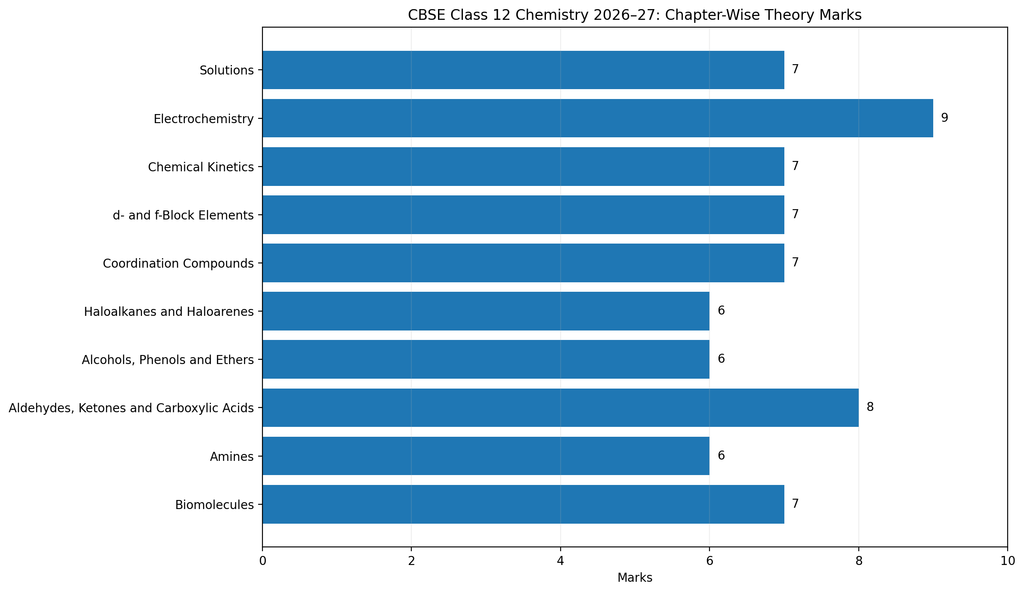
CBSE Class 12 Chemistry Chapter-Wise Marks 2026–27
The official unit-wise marks distribution is:
| Unit | Chapter | Marks |
|---|---|---|
| 1 | Solutions | 7 |
| 2 | Electrochemistry | 9 |
| 3 | Chemical Kinetics | 7 |
| 4 | d- and f-Block Elements | 7 |
| 5 | Coordination Compounds | 7 |
| 6 | Haloalkanes and Haloarenes | 6 |
| 7 | Alcohols, Phenols and Ethers | 6 |
| 8 | Aldehydes, Ketones and Carboxylic Acids | 8 |
| 9 | Amines | 6 |
| 10 | Biomolecules | 7 |
| Total | 70 |
Source: CBSE Class XII Chemistry Curriculum 2026–27.
Which Chapter Has the Highest Weightage in Class 12 Chemistry?
According to the official course structure, Electrochemistry carries 9 marks, making it the highest-weightage individual unit.
It is followed by:
- Aldehydes, Ketones and Carboxylic Acids – 8 marks
- Solutions – 7 marks
- Chemical Kinetics – 7 marks
- d- and f-Block Elements – 7 marks
- Coordination Compounds – 7 marks
- Biomolecules – 7 marks
Students should not interpret this as a reason to leave 6-mark chapters. A difference of one or two marks is small, and questions from several chapters can test interconnected concepts.
The better strategy is to use weightage to decide revision time, not to decide which chapters can be skipped.
Detailed CBSE Class 12 Chemistry Syllabus 2026–27
Unit 1: Solutions – 7 Marks
Solutions is one of the main Physical Chemistry units in Class 12.
According to CBSE, students need to study areas such as:
- Types of solutions
- Expression of concentration of solutions
- Solubility
- Vapour pressure of liquid solutions
- Ideal and non-ideal solutions
- Colligative properties
- Determination of molar mass
- Abnormal molecular masses
What Should Students Focus On?
Students should be comfortable with concentration terms such as molarity and mole fraction and understand how they are used in numerical questions.
Colligative properties are especially important because questions may require both conceptual understanding and calculations.
Do not simply memorise equations. Learn:
- what each quantity represents,
- which formula applies under which condition, and
- how units must be converted before calculation.
Unit 2: Electrochemistry – 9 Marks
Electrochemistry carries 9 marks, the highest allocation among the 10 theory units in CBSE’s 2026–27 course structure.
The syllabus includes:
- Electrochemical cells
- Galvanic cells
- Nernst equation
- Conductance of electrolytic solutions
- Electrolytic cells
- Electrolysis
- Batteries
- Fuel cells
- Corrosion
Why Electrochemistry Needs Extra Practice
Electrochemistry combines theory with numerical application.
Students frequently need to connect ideas such as:
electrode potential → cell potential → Nernst equation → feasibility of an electrochemical process
Instead of treating these as isolated formulas, understand the relationship between them.
Numerical practice is particularly useful for:
- Nernst equation
- Conductivity and molar conductivity
- Electrochemical cell calculations
Keep a separate one-page formula sheet for this unit and revise it regularly.
Unit 3: Chemical Kinetics – 7 Marks
Chemical Kinetics deals with how quickly reactions occur and the factors that affect their rates.
The official syllabus covers:
- Rate of a chemical reaction
- Factors influencing reaction rate
- Integrated rate equations
- Temperature dependence of reaction rate
- Collision theory of chemical reactions
Important Areas to Prepare
Students should understand the difference between:
- rate of reaction,
- rate constant,
- reaction order, and
- molecularity.
Integrated rate equations require careful numerical practice.
Simply remembering formulas without knowing the reaction order to which they belong often causes mistakes.
Solve questions where you have to identify the order of a reaction from the given data rather than being told the order directly.
Unit 4: d- and f-Block Elements – 7 Marks
This is an important Inorganic Chemistry unit.
CBSE includes:
- Position in the periodic table
- Electronic configuration of d-block elements
- General properties of transition elements
- Important compounds of transition elements
- Lanthanoids
- Actinoids
- Applications of d- and f-block elements
How to Prepare This Chapter
This chapter becomes easier when information is organised into comparison tables.
For example, prepare concise notes for:
- electronic configurations,
- oxidation states,
- colour,
- magnetic behaviour,
- catalytic behaviour,
- lanthanoid contraction.
Avoid memorising isolated statements without understanding periodic trends.
Unit 5: Coordination Compounds – 7 Marks
Coordination Compounds is another major Inorganic Chemistry chapter.
The prescribed topics include:
- Werner’s theory
- Important terminology related to coordination compounds
- Nomenclature
- Isomerism
- Bonding in coordination compounds
- Bonding in metal carbonyls
- Importance and applications of coordination compounds
Areas That Need Regular Practice
Students should practise nomenclature rather than only reading the naming rules.
You should be able to move in both directions:
formula → IUPAC name
and
IUPAC name → formula
Isomerism and bonding also need conceptual clarity.
Create a small vocabulary sheet containing terms such as ligand, coordination number, coordination entity, chelation and oxidation state.
Unit 6: Haloalkanes and Haloarenes – 6 Marks
This unit begins the major Organic Chemistry portion of the syllabus.
CBSE includes:
- Classification
- Nomenclature
- Nature of the C–X bond
- Methods of preparation of haloalkanes
- Preparation of haloarenes
- Physical properties
- Chemical reactions
- Polyhalogen compounds
How to Study Haloalkanes and Haloarenes
Reaction-based chapters become difficult when students try to memorise every reaction independently.
A better approach is to organise reactions according to:
Reactant → Reagent/Condition → Product → Reaction Type
When revising, try writing the product before checking your notes.
Unit 7: Alcohols, Phenols and Ethers – 6 Marks
The official syllabus covers:
- Classification
- Nomenclature
- Structures of functional groups
- Alcohols and phenols
- Commercially important alcohols
- Ethers
Students should pay attention to the differences in chemical behaviour of alcohols and phenols.
Preparation methods, reactions and conversions should be revised repeatedly rather than studied once.
Organic Chemistry becomes much easier when related reactions are connected into conversion maps.
Unit 8: Aldehydes, Ketones and Carboxylic Acids – 8 Marks
At 8 marks, this is one of the higher-weightage units in the Class 12 Chemistry course structure.
CBSE prescribes:
Aldehydes and Ketones
- Nomenclature
- Structure of the carbonyl group
- Preparation
- Physical properties
- Chemical reactions
- Uses
Carboxylic Acids
- Nomenclature
- Structure of the carboxyl group
- Methods of preparation
- Physical properties
- Chemical reactions
- Uses
How to Prepare This Unit
Make reaction maps instead of long handwritten paragraphs.
For example:
Primary alcohol → Aldehyde → Carboxylic acid
Once students see how compounds are chemically connected, conversion questions become easier to solve.
Also practise identifying which reagent can selectively bring about a particular transformation.
Unit 9: Amines – 6 Marks
Amines is an important Organic Chemistry unit that also includes diazonium salts.
The CBSE syllabus covers:
- Structure of amines
- Classification
- Nomenclature
- Preparation
- Physical properties
- Chemical reactions
- Preparation of diazonium salts
- Physical properties of diazonium salts
- Chemical reactions of diazonium salts
- Importance of diazonium salts in the synthesis of aromatic compounds
Important Preparation Tip
Do not study diazonium salts separately from aromatic conversions.
Prepare a reaction flowchart showing how aniline can be converted into a diazonium salt and how the diazonium salt can subsequently be converted into other compounds.
This gives you a much stronger understanding of the chapter.
Unit 10: Biomolecules – 7 Marks
Biomolecules carries 7 marks in the official course structure.
The syllabus covers:
- Carbohydrates
- Proteins
- Enzymes
- Vitamins
- Nucleic acids
- Hormones
Biomolecules is different from calculation-heavy chapters such as Electrochemistry.
The emphasis here should be on understanding classifications, structures, examples and biological significance.
Tables and comparison charts are especially useful.
For example:
| Topic | What to Revise |
|---|---|
| Carbohydrates | Types, examples and structures |
| Proteins | Amino acids and levels of structure |
| Enzymes | Nature and functions |
| Vitamins | Types and significance |
| Nucleic Acids | DNA and RNA concepts |
| Hormones | Basic role and examples |
Topics Included for Formative Assessment
Students should pay close attention to one important note in the official CBSE curriculum.
CBSE lists certain topics as part of the syllabus but states that they are to be assessed only formatively, meaning they are intended to reinforce learning without adding to the summative assessment burden.
These topics include:
- Surface Chemistry
- General Principles and Processes of Isolation of Elements
- Polymers
- Chemistry in Everyday Life
This distinction is useful because students sometimes rely on old syllabus lists available online and become confused about whether these chapters are part of the board theory examination.
Always check the current-session CBSE curriculum rather than relying on a syllabus from an earlier academic year.
CBSE Class 12 Chemistry Practical Marks 2026–27
Chemistry is evaluated out of 100 marks, of which 30 marks are allocated to practical work.
The official CBSE practical evaluation scheme is:
| Practical Component | Marks |
|---|---|
| Volumetric Analysis | 8 |
| Salt Analysis | 8 |
| Content-Based Experiment | 6 |
| Project Work | 4 |
| Class Record and Viva | 4 |
| Total | 30 |
That means practical Chemistry represents 30% of the total Chemistry marks.
Students should therefore avoid leaving practical preparation until the final few days.
What Does the Practical Syllabus Include?
The official curriculum includes laboratory work involving areas such as:
- Basic laboratory techniques
- Melting point determination
- Boiling point determination
- Crystallisation
- pH-based experiments
- Volumetric analysis
- Salt analysis
- Content-based experiments and project work
While preparing for practicals, learn not only the procedure but also the chemistry behind the experiment. This will help during the viva.
Physical, Organic and Inorganic Chemistry: How Are the 70 Marks Distributed?
A useful way to understand Class 12 Chemistry is to group the units.
Physical Chemistry
- Solutions – 7
- Electrochemistry – 9
- Chemical Kinetics – 7
Total: 23 marks
Inorganic Chemistry
- d- and f-Block Elements – 7
- Coordination Compounds – 7
Total: 14 marks
Organic Chemistry and Biomolecules
- Haloalkanes and Haloarenes – 6
- Alcohols, Phenols and Ethers – 6
- Aldehydes, Ketones and Carboxylic Acids – 8
- Amines – 6
- Biomolecules – 7
Total: 33 marks
These totals are calculated directly from CBSE’s official chapter-wise course structure.
This does not mean students should prepare the three branches in isolation. Board questions can test conceptual understanding and application rather than simple recall.
How to Prepare for CBSE Class 12 Chemistry 2026–27
1. Finish NCERT Before Collecting Too Many Reference Books
For board preparation, your first objective should be to understand the prescribed concepts thoroughly.
Read the chapter, solve examples and complete relevant exercises before moving to large collections of additional questions.
Too many resources often lead to incomplete preparation.
2. Treat Physical Chemistry as a Practice Subject
For Solutions, Electrochemistry and Chemical Kinetics, make a formula sheet and solve numerical problems regularly.
Do not read solved examples passively.
Cover the solution, attempt the problem yourself and then compare your steps.
3. Build Reaction Maps for Organic Chemistry
Organic Chemistry becomes difficult when every reaction looks unrelated.
Prepare connected reaction maps containing:
starting compound → reagent → intermediate/product
Revise these maps repeatedly.
4. Use Tables for Inorganic Chemistry
For d- and f-Block Elements and Coordination Compounds, comparison tables can significantly reduce revision time.
Use separate columns for:
- configuration,
- oxidation state,
- colour,
- magnetic behaviour,
- important reactions,
- exceptions.
5. Practise the Official Sample Paper
CBSE has officially published the Class XII Sample Question Papers and Marking Schemes for the 2026–27 session, including Chemistry.
After completing the syllabus, attempt the official sample paper in examination conditions.
Do not immediately check the answer when you get stuck.
Complete the paper first, then analyse:
- conceptual errors,
- calculation mistakes,
- reactions you forgot,
- questions that consumed too much time.
That error analysis is usually more useful than simply counting your marks.
A Practical Study Priority Based on Chapter Weightage
Marks alone should never decide whether a chapter is studied, but they can help determine how much revision time to allocate.
Higher Priority for Intensive Practice
Electrochemistry – 9 marks
Focus strongly on concepts and numericals.
Aldehydes, Ketones and Carboxylic Acids – 8 marks
Practise reactions, conversions and conceptual questions.
Strong Core Chapters
The following units carry 7 marks each:
- Solutions
- Chemical Kinetics
- d- and f-Block Elements
- Coordination Compounds
- Biomolecules
These chapters together account for 35 marks, exactly half of the 70-mark theory structure.
Do Not Neglect the 6-Mark Chapters
- Haloalkanes and Haloarenes
- Alcohols, Phenols and Ethers
- Amines
Together, these three chapters contribute 18 marks.
Leaving them weak can create a substantial gap in board preparation.
Common Mistakes Students Make While Preparing Class 12 Chemistry
Memorising formulas without knowing when to use them
This creates problems in Physical Chemistry whenever the question is presented differently from familiar textbook examples.
Reading Organic Chemistry instead of writing reactions
You remember reactions much better when you reproduce them from memory.
Ignoring NCERT details in Inorganic Chemistry
Small factual points and conceptual distinctions can matter.
Studying only high-weightage chapters
The official marks difference between most chapters is small. A 6-mark chapter is not unimportant compared with a 7-mark chapter.
Ignoring practical Chemistry
The practical component carries 30 marks, making it a significant part of the final result.
Final Preparation Checklist
Before the board examination, a student should ideally be able to say yes to the following:
- I have completed all 10 theory units.
- I have revised all Physical Chemistry formulas.
- I can solve Electrochemistry and Chemical Kinetics numericals without looking at solutions.
- I have prepared Organic Chemistry reaction maps.
- I have revised important Inorganic Chemistry trends and terminology.
- I have practised nomenclature in Coordination Compounds.
- I have revised Biomolecules using tables and short notes.
- I have prepared the practical experiments and viva concepts.
- I have attempted the official CBSE 2026–27 sample paper.
- I have revised my mistakes rather than only solving new questions.
Final Thoughts
The CBSE Class 12 Chemistry syllabus 2026–27 is manageable when preparation is divided according to the nature of each chapter.
The theory examination carries 70 marks across 10 units, while practical work contributes another 30 marks. Electrochemistry has the highest individual unit allocation at 9 marks, followed by Aldehydes, Ketones and Carboxylic Acids at 8 marks.
However, students should avoid treating chapter weightage as a shortcut for selective study. Most chapters carry between 6 and 9 marks, so complete syllabus coverage remains important.
Start with concepts, practise NCERT-based questions, build a regular revision routine and use the official CBSE sample paper to test your preparation.
Students who find Physical Chemistry numericals, Organic Chemistry reactions or Inorganic Chemistry concepts difficult can also benefit from personalised guidance from an experienced Class 12 Chemistry home tutor, especially when regular doubt-solving and board-focused practice are required.
Frequently Asked Questions
What is the CBSE Class 12 Chemistry syllabus for 2026–27?
The syllabus contains 10 main theory units: Solutions, Electrochemistry, Chemical Kinetics, d- and f-Block Elements, Coordination Compounds, Haloalkanes and Haloarenes, Alcohols Phenols and Ethers, Aldehydes Ketones and Carboxylic Acids, Amines and Biomolecules.
How many marks are there in CBSE Class 12 Chemistry?
Class 12 Chemistry is evaluated for 100 marks, consisting of 70 marks theory and 30 marks practical.
Which chapter has the highest weightage in Class 12 Chemistry 2026–27?
Electrochemistry has the highest individual allocation at 9 marks in CBSE’s official course structure.
How many marks does Organic Chemistry carry in Class 12?
The marks assigned to Haloalkanes and Haloarenes, Alcohols Phenols and Ethers, Aldehydes Ketones and Carboxylic Acids and Amines total 26 marks. If Biomolecules is included in the broader organic/biochemistry grouping, these five units account for 33 marks of the course structure.
How many marks does Physical Chemistry carry?
Solutions, Electrochemistry and Chemical Kinetics together account for 23 marks in the official 70-mark theory course structure.
Is the Class 12 Chemistry practical exam important?
Yes. The practical examination carries 30 marks. Volumetric Analysis and Salt Analysis carry 8 marks each, while the remaining marks come from content-based experiments, project work, class record and viva.
Are Polymers and Chemistry in Everyday Life included in the 2026–27 syllabus?
CBSE lists Polymers, Chemistry in Everyday Life, Surface Chemistry and General Principles and Processes of Isolation of Elements as topics to be assessed formatively, rather than as part of summative assessment.
Has CBSE released the Class 12 Chemistry sample paper for 2026–27?
Yes. CBSE has published Class XII Sample Question Papers and Marking Schemes for the 2026–27 academic session, including Chemistry.