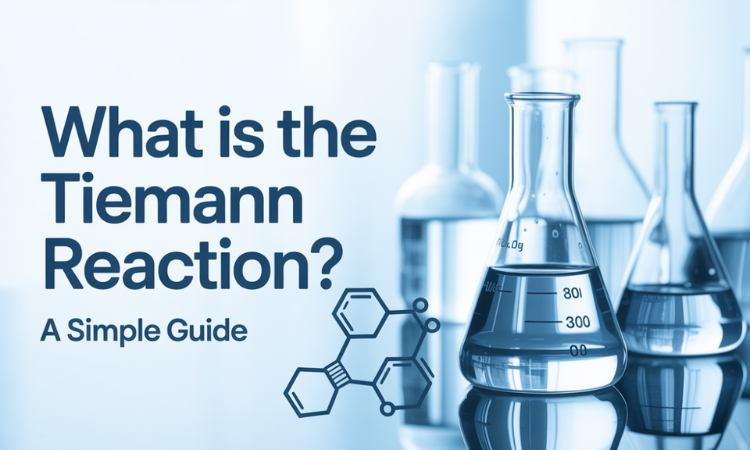
What Is the Tiemann Reaction? A Simple Guide for Organic Chemistry Students
For every student, chemistry is one of those subjects in which organic chemistry is quite difficult to understand. This is mainly because of a lack of conceptual clarity in the subject. As a result, students are not able to solve organic chemistry questions in examinations. The Tiemann reaction is also known as Reimer–Tiemann Reaction.This is a very important reaction of organic chemistry that helps students to understand the functional groups that are introduced in aromatic compounds. This is a chemical reaction used for the ortho-formylation of phenols, with the simplest example being the conversion of phenol to salicylaldehyde. The reaction was first reported by Karl Reimer and Ferdinand Tiemann. Historical Background The Tiemann reaction is an organic chemical reaction used for the formation of phenol derivatives. In this reaction, phenol reacts with chloroform (CHCl₃) in the presence of a base, which leads to the formation of an aldehyde group (–CHO). This reaction is an example of the conversion of salicylic aldehyde. This reaction was discovered in 1876 by Karl Reimer and Ferdinand Tiemann, both of whom were German chemists. This reaction provides a direct method for introducing a formyl group (–CHO) into phenolic compounds.These reactions are widely used in the chemical industry. Also Read: Ace Chemistry Boards in Just 30 Days Requirements for the Tiemann Reaction For the Tiemann reaction, the following chemical substances are required: Phenol Chloroform (CHCl₃) Aqueous sodium hydroxide (NaOH) Water (H₂O) The alkaline medium required for this reaction converts phenol into the phenoxide ion. Conditions Required for the Reaction Temperature: 60–70 °C The reaction environment must be alkaline. Mechanism of the Tiemann Reaction (Step-by-Step) The Reimer Tiemann reaction is a simple way to turn phenol into salicylaldehyde using chloroform and a strong base like NaOH. First, phenol turns into phenoxide ion in alkaline water. Then, it reacts with a reactive dichlorocarbene from chloroform, adding an aldehyde group next to the OH on the ring. Mastering the Reimer Tiemann reaction mechanism builds easy understanding of key organic chemistry for exams and real uses in medicines, dyes, and perfumes. For the formation of the Tiemann reaction, several steps need to be followed: Step 1:- In the presence of a strong base (NaOH or KOH), chloroform loses a proton, which leads to the formation of dichlorocarbene (: CCl₂). Reaction: CHCl₃ + OH⁻ → :CCl₂ + Cl⁻ + H₂O Step 2:- Now, phenol reacts with the base to form the phenoxide ion (C₆H₅O⁻). Step 3:- The dichlorocarbene acts as an electrophile. In this reaction, a dichloromethyl intermediate is formed. Step 4:- The –CCl₂ group is hydrolyzed in an alkaline medium. Step 5:- Due to acidic work-up, the phenoxide ion is converted back into phenol, and salicylaldehyde is formed as the final product. E.g of this reaction – C₆H₅OH + CHCl₃ + 3NaOH→ o-hydroxybenzaldehyde (salicylaldehyde) + p-hydroxybenzaldehyde + 3NaCl + 2H₂O Applications of the Tiemann Reaction The Tiemann reaction is used in various industrial production processes. (1) Pharmaceutical Industry:- Salicylaldehyde is an important component in the preparation of antiseptic, analgesic, and anti-inflammatory medicines. (2) Dye and Perfume Industry:- It is used for the pigmentation of clothes in the dye industry. (3) Flavouring and Fragrance Industry:- It is used in the formation of vanillin essence and is also used in the manufacturing of fragrances in the perfume industry. How the Right Teaching Approach Makes Organic Chemistry Easier Organic chemistry is not difficult if it is taught in the right way with proper conceptual clarity of the subject. With clear concepts, it becomes easy to understand reactions. This is possible when students receive the right teaching approach. Most students face difficulty in solving organic chemistry questions in examinations due to the following reasons: Trying to memorize reactions instead of understanding the concepts. Lack of conceptual clarity about the uses of reagents, intermediates, and reaction conditions. Inability to link theory with reactions. These points highlight the importance of concept-based teaching, which develops logic and understanding. By focusing on concepts, there is no need to memorize reactions because conceptual clarity helps students understand reactions easily. All of this can be achieved by a good teacher who helps students understand the subject rather than memorize it. The best chemistry teacher in India can connect theory with reactions. As a result, students are able to solve organic chemistry reactions easily by applying the concepts they have learned. Exam-Oriented Insights and Key Takeaways The best teachers help students prepare in an exam-oriented manner, so there is no need to take extra pressure. For multiple revisions of concepts, teachers encourage students to make short notes. Solving previous years’ questions (PYQs) helps in understanding the key takeaways of the subject. With regular practice, students can solve more organic chemistry questions. This helps reduce mistakes during exams and builds confidence. As a result, students can perform to the best of their ability in examinations. Quick Revision Summary For quick revision of the whole topic, try to compile all important reactions and concepts on a single page. This will help you revise multiple concepts at one time. To understand concepts better, first write the reactions and then note down the concept behind each reaction, along with examples. Do not simply make a list of reactions. For revision, explaining concepts with examples helps in making a summary note of the whole chapter. Conclusion Chemistry is a subject that depends heavily on strong conceptual understanding, as clear concepts from the foundation of learning and mastering your reactions in organic chemistry rely only on learning; this often leads to confusion about reactions, but the right concept-based learning helps students to understand organic chemistry reactions smartly and apply them effectively. To get a proper understanding of organic chemistry, students need a teacher who focuses on concept clarity, reasoning, and application of reactions. Anil Kumar Lal, sir, is one of the best chemistry teachers in India. He is known for building deep conceptual clarity among students. Through the Chemistry Home Tutor, you can understand complicated topics like Reimer Reaction and Tiemann reaction in a very simple